




-
 SaleVendor:The Claw
The Claw High-Strength Aircraft Tie Down Anchors
Regular price $134.99Sale price $134.99 Regular priceUnit price per$169.99
Aircraft tie down anchors that secure your airplane on any surface
An aircraft tie down anchors a parked airplane against wind so it stays put when you walk away, on a ramp, a grass strip, or a remote backcountry surface. The challenge is that fixed ramp tie-down rings are not everywhere you fly, and screw-in stakes can fight you in hard-packed ground and add up over multiple points. Pilot Mall stocks The Claw High-Strength Aircraft Tie Down Anchors, a self-contained portable kit that drives into grass and dirt with no fixed rings required, sets up in under two minutes, and delivers 1,200 lbs of holding power per anchor. Thousands of pilots trust this system to protect their Cessnas, Pipers, and experimental aircraft.
Types of aircraft tie down systems
Portable anchor kits
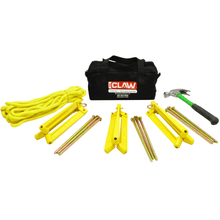
A portable anchor kit is a self-contained set you carry with you, so you are never dependent on whatever happens to be on the ground when you land. The Claw is the kit Pilot Mall stocks: three anchors, nine rust-proof spikes, 30 feet of rope, a hammer, and a carry bag, all aluminum and all packing down for the baggage compartment. It sets up in under two minutes with no fixed ramp rings required, which is why it is the go-to choice for grass, dirt, and unimproved strips.
Screw-in and auger-style stakes
Screw-in and auger stakes thread a single spiral anchor into the ground at each tie-down point. They hold well in soft, consistent soil when you return to the same surface, but they can be slow to seat in hard-packed ground and the per-point cost grows once you need to cover both wings and the tail. They are not stocked in this collection; pilots who want a grab-and-go alternative usually choose a portable kit instead.
Wheel chocks and gust locks
Wheel chocks block the tires so the aircraft cannot roll on a sloped or uneven surface, and a gust lock immobilizes the control surfaces so wind cannot slam the ailerons, elevator, and rudder while the airplane is parked. Both are complementary layers to a good tie-down, not replacements for it. Pilot Mall does not currently stock chocks or gust locks in this collection, so plan those separately if your parking situation calls for them.
Why pilots choose The Claw
The Claw uses a mechanical-advantage anchor design that grips harder the harder it is pulled, so a rising wind load tightens the bite into the ground rather than loosening it. Each kit includes three anchors with nine rust-proof spikes, 30 feet of rope, a hammer, and a carry bag, all built from aluminum for repeated all-weather use and backed by a lifetime warranty. With 1,200 lbs of holding power per anchor and an under-two-minute setup that needs no fixed ramp rings, it covers a three-point tie-down on most single-engine general aviation aircraft straight out of the bag. Pilots trust it to protect Cessnas, Pipers, and experimental aircraft on surfaces where ramp rings simply do not exist.
How to choose the right aircraft tie down
- Match the system to the surface. If you fly to grass, dirt, gravel, or backcountry strips, choose a portable anchor kit like The Claw that drives into the ground where fixed rings are not available.
- Plan your anchor points. A three-point setup secures both wings and the tail of most single-engine aircraft; larger or twin-engine airplanes may want a second kit for full coverage.
- Think about portability. If you fly away and overnight elsewhere, a kit that packs into a carry bag beats anything you cannot bring with you.
- Size the holding power to the wind. Heavier aircraft and exposed, gust-prone ramps demand more holding power; The Claw provides 1,200 lbs per anchor across a three-point setup.
- Add complementary layers when needed. Wheel chocks stop rolling on slopes and a gust lock protects control surfaces; use them alongside, not instead of, your tie-down.
Tie-downs are one layer of ramp protection. Keep the airframe clean with our aircraft cleaning and polishing supplies, and round out ownership gear in aircraft supplies and pilot supplies. For the cockpit, see cockpit supplies, kneeboards, and logbooks, or browse flight bags. Shopping for the owner who has everything? Try pilot gifts and aviation home decor.
Why buy from Pilot Mall
- Aviation-only focus: we sell pilot gear and nothing else, so every product is chosen for real flying.
- Trusted for more than 25 years by student, recreational, and professional pilots.
- Genuine product backed by the manufacturer warranty, including The Claw's lifetime warranty.
- Free U.S. shipping over $100.
- Expert guidance from a team that flies and knows the gear.
Frequently Asked Questions
How do you tie down an airplane?
Secure the airplane at three points: a rope or strap from each wing tie-down ring and one from the tail, each running down to a ground anchor. Set the anchors so the lines pull at roughly a 45-degree angle, leave a little slack for line stretch, and never tie to a lift strut.
How many tie-down points does an airplane need?
Most single-engine general aviation aircraft use three tie-down points: both wings and the tail. Twin-engine and larger airplanes often need additional points, so a single three-anchor kit may not cover them and a second kit can be added for full coverage.
What is the FAA 45-degree tie-down method?
The 45-degree method positions each ground anchor so the tie-down line meets the wing or tail ring at about a 45-degree angle. This balances downward and outward load, resisting both lift and side movement in gusty wind far better than a line that runs straight down or pulls nearly horizontal.
Do screw-in anchors or portable anchor kits hold better in wind?
Both can hold well, but it depends on the surface. Screw-in stakes excel in soft, consistent soil you return to repeatedly, while a portable kit like The Claw goes anywhere and uses a mechanical-advantage design that grips harder as the wind load increases, which is why fly-away and backcountry pilots favor it.
Will The Claw work on grass, dirt, and backcountry strips?
Yes. The Claw is designed for exactly those surfaces. Its rust-proof spikes drive into grass and dirt with the included hammer, no fixed ramp rings required, so you can anchor securely on unimproved and backcountry strips where standard tie-down rings do not exist.
How much holding power do aircraft tie-down anchors need?
Holding power should match the aircraft weight and the wind you expect, with exposed ramps and heavier airplanes demanding more. Spreading the load across a three-point setup matters as much as any single number. The Claw provides 1,200 lbs of holding power per anchor across its three-point kit.
